If you're a regular reader at my blog, I'm sure you've wondered where I've been off to since this weekend. I hate to say it, but we're still very ill in this household. We found mold and had sprayed for it, but the kids have a nasty bacterial virus they'd picked up and spread to us, and my husband spent yesterday at the doctor's office being told he's going to be home with us for another week resting adn recuperating. Oy.
So, without further ado, I'd like to talk about Milk Kefir with you.
What is Milk Kefir?
The term kefir' is of Turkish origin, from köpür → köpük (foam)...
Kefir grains are a combination of bacteria and yeasts in a matrix of proteins, lipids, and sugars, and this symbiotic matrix forms "grains" that resemble cauliflower. For this reason, a complex and highly variable community of lactic acid bacteria and yeasts can be found in these grains.
Kefir grains contain a water-soluble polysaccharide known as kefiran,
which imparts a rope-like texture and feeling in the mouth; it ranges
in color from white to yellow, and may grow to the size of walnuts. Wikipedia: Kefir
In addition to beneficial bacteria and yeast, kefir contains many
vitamins, minerals, amino acids and enzymes. Particularly
calcium, phosphorus, magnesium, B2 and B12, vitamin K,
vitamin A and vitamin D. Tryptophan, one of the essential
amino acids abundant in kefir, is well known for its relaxing
effect on the nervous system. Because kefir also has an abundance
of calcium and magnesium, also important minerals for a healthy
nervous system, kefir in the diet can have a particularly calming
effect on the nerves.
Seeds of Health: Fermenting Milk Kefir
The
numerous benefits of maintaining adequate B vitamin intake range from
regulation of the kidneys, liver and nervous system to helping relieve
skin disorders, boost energy and promote longevity.
Kefir.net See also Nourished Kitchen: Milk Kefir
Shortly after I had purchased my first batch of tibicos and my Kombucha SCOBY from Wellness-Drinks.de, I heard about milk kefir. I've been battling some issues revolving around malabsorption issues that tend to accompany Celiac disease, and I have a very difficult time getting enough B vitamins. I could eat all my vitamins plus supplement all the day long, and still not get enough with as damaged as my gut is. Milk Kefir, Tibicos and Kombucha to the rescue!!
Actually, I was thinking something more like "What the heck, it couldn't hurt, right? I'm already headed towards iron infusions!" - which is where I ended up for a good three months. Right now my numbers are ok, but I am continuing towards good health with the help of my little fermenting friends.
One thing that I have found is that Milk Kefir is way out there in the realm of awesome when it comes to baking gluten free baked goods. I haven't tried it with any Paleo or GAPS recipes yet, but I have had great success using it with variations of Bette Hagman's Featherlight Flour mix to make Mrsppmrxky's Featherlight biscuits.
Mrsppmrxky is my mom. If there is one thing she has encouraged since I've moved overseas, is to play around with her recipes and get back to her about changes I've made. I'm still trying to sell her on milk kefir.
That's OK though. I'm loving it. So far, I've made sour cream, and thick yogurt with it. I've not ventured into any lacto-fermenting, mostly as I have no room in my kitchen, or anywhere else for me to allow that to take place, and I'm terribly worried it'd get knocked over and the mess would be everywhere, or, G-d forbid, it'd end up in a horrible moldy mess.
Without further ado, I'll share a few more sites about Kefir, and let you investigate this wonderful SCOBY and see if it is something that you would like to add into your life.
My Kombucha Tea in an Ikea jar
Take note that there is no seal on this jar!!
Today we are going to talk about Kombucha Tea. Kombucha is a very helpful probiotic for anyone, but is especially helpful in a gluten free, Paleo, Primal, SCD or GAPS diet.
This is a long post, so be sure to snuggle up under a blanket and take your time watching the videos and reading all the links.
Just what is Kombucha exactly?
Kombucha is an effervescent tea-based beverage that is often consumed for its anecdotal health benefits or medicinal purposes. Kombucha is available commercially and can be made at home by fermenting tea using a visible, solid mass of yeast and bacteria which forms the kombucha culture, often referred to as 酵母 (kombo, lit. "yeast mother", see etymology for disambiguation with 昆布, kombu, kelp). http://en.wikipedia.org/wiki/Kombucha
Kombucha SCOBY. Source: Google
To your left is a Kombucha SCOBY. This is probably what yours will look like if you get it from a friend or purchase one online.
You may also get one that is "torn" or cut in pieces. Mine is apparently
part of a larger SCOBY at the dealer I got it from, and was cut in
quarters. Mine's just a little corner piece. It will float to the top and start making another SCOBY on top of
itself every brew.
One thing you will want to do with your SCOBY is to be sure and handle it with washed hands, not just when you place it into the tea, but also while it is brewing.
...Kombucha has the ability to mutate to
fit the needs of the person making the ferments. Handling the colonies
leaves personal bacteria on the colony and hence in the ferment.
Kombucha will either incorporate the 'good' bacteria or produce an
anti-bacteria to fight the bad ones. The effect is that the kombucha
ferment mutates to help the specific health of the person preparing it.
I think this is why kombucha can apparently help so many diverse
health conditions. I am not at all sure that kombucha is not a direct
gift from God since it can not survive without direct help from man.)
http://users.sa.chariot.net.au/~dna/kombucha.htm
I've been asked many times what Kombucha tastes like. Well, it really depends on several factors. What kind of tea you are using, how long you are brewing it, how much air you have getting to it, and your current weather/temperature in your home.
I think the taste also changes depending on the type of glass you serve
it in. I'd been drinking it in a narrow-mouthed glass and it tasted
cidery. Same batch, different glass (brandy glass with a wider mouth and
bottom) and it tasted more like nestea without "enough" sugar. Now -
remember I grew up in Southern culture so sweet tea is the norm, 1
gallon with 1-2 cups of sugar in that mother. It's so sweet it will rot
your teeth out of your head. This is just not that.
Q. What does kombucha taste like?
A. The taste of kombucha varies greatly
depending on the amount of time it was allowed to ferment and
whether or not flavoring was added. For example, fermentation time
determines whether the kombucha tea has a very mild taste or a very
strong vinegar taste (kombucha is made using a method very similar to
the one used to make vinegar). If you desire a more sweet taste, we
recommend a very short brewing period 5+ days. If the vinegar taste
doesn't bother you, a longer fermentation process will allow the tea
to fully culture. When first making kombucha, we recommend you
taste the kombucha starting at day 7 (using a straw makes this
easier) to determine at what point you wish to stop the fermentation
process. Adding fruit or juice following fermentation can sweeten
the kombucha. Alternatively, you can add water to the finished
kombucha prior to drinking to cut the flavor. Click here for more
information on influencing the flavor of homemade kombucha. http://www.culturesforhealth.com/kombucha-tea-frequently-asked-questions-faq
It's hard to compare the taste of kombucha (comb-boo-cha) to
anything else. Vinegary, fizzy, cider-y, or just plain nasty if you
haven't given it a chance yet. Then again, some people (particularly
those who drank vinegar as a kid) like it from sip one.
...The enzymes boost your energy without the post-caffeine lows and headachey shakes, making you feel rejuvenated, restored, and pretty happy. It has something to do with the "mother cell,"
a mini jellyfish-looking blob floating around, which, if you really
want to know, is a yeast and bacterial colony where the sugars are
digested. With the addition of tea, this microorganism party ferments
into a tangy, sparkling drink.
http://www.seriouseats.com/2010/03/kombucha-fermented-tea-gts-honest-tea-brewing-drinks.html
I love this comment at the end of the article by a subby. I think it sums up nicely.
I really like Kombucha but it takes some getting used to. My mom used to
try to get me to a drink a version of it when I was little, and let me
tell you, it did NOT have fruit juice mixed in. It was smelly, warm
and I wasn't having it.
These days I crave it at least once a week. I love the buzz it gives you and I think it tastes pretty good.
Serious Eats article
There has been some concern expressed by some friends and family about the alcohol content of Kombucha. Please read these if this is one of your concerns:
This may be out of order. (I hope not! I tried to get it right, but it is not numbered on youtube) This set of videos is from a Kombucha "camp" that explains everything you need to know to get started. Ms. Crum's site is http://www.kombuchakamp.com/
She mentions using spring water - I would say DO NOT use well water or
tap water. I use Vittel or a similar brand of still mineral water. Always. Make sure you change your
cloth often as it will attract fruit flies. So, keep fly-eating plants
nearby, but do not brew anything else fermented or keep any house plants
nearby that pollinate!
I have heard that you can also brew your kombucha with Yerba Mate instead of tea. Below are a few videos about that.
Warning: very long schpiel. (16 minutes!)
This is my SCOBY when I first got it last year.
Notice how it is on the bottom. Generally, this
is where it will start before it begins floating.
Don't ever wash your glass brewing jar unless you take a break or need to start over due to mold.
If you get a batch that's too sour it makes an excellent marinade.
I don't eat the fruit from the second brew, but you can.
You can also eat the SCOBY. If you end up with lots of
babies, it's 100% fine to consume them.
There should always be a baby. Always. They can often be stuck to
the mother but if there truly is no baby your culture is off. You should
split them, not keep them together indefinitely.
You can supposedly make kombucha with honey. I've never tried it, though.
To be GAPS compatible you need to ferment away as much sugar as
possible while still keeping it palpable. Most GAPSters do the first
ferment a really long time then do a second ferment with fruit to make
it more palatable.
I don't use any spiced or flavored teas but some do. DO NOT use Earl Gray, the bergamot will kill your SCOBY. Orange pekoe is a variety of black tea. So is darjeeling. Herbal tea will not work. You might get something but it won't be kombucha and it wouldn't be safe to consume.
You can use a green tea as a portion of your tea but if you
use 100% green tea, the SCOBY will not ferment the sweet tea properly.
This is my SCOBY Hotel.
Notice that there is tea in this from my last batch.
The SCOBY in here is also from the batch of tea in the jar.
One thing you will want to do with your dear little SCOBY is make a SCOBY Hotel. This is a lifesaver, especially if you have issues with fruit flies, mold or other "oopsies" in your household. I once had to let a SCOBY go in the trash after it got infested last year with fruit flies. Somehow the flies got their eggs past my wash cloth barrier (this is why I now use the glass I use!!!) and laid their eggs right on top of my SCOBY. I cried buckets. I tore the baby off the mother. I washed the mother SCOBY very well and I began brewing again. At that point, I did not have a SCOBY hotel, because I only really had one SCOBY. Now, I always have a backup, because I know - as the saying goes - "Shit happens". It really, really does.
SCOBYs are an investment here in Germany and I purchased mine through Wellness Drinks. You can get them from Kombucha Kamp in the USA. I also got my large brewing glasses and lids from them (you don't have to do that if you have other large glass jars you plan on using), and I purchased my Milk Kefir and Water Kefir (Tibicos) from them. I'm really happy with my purchase, and they were not too expensive when you compare their prices and shipping with other shops here in Germany and the EU.
So, if you need any and you're here in Germany, one way to get a SCOBY is to ask a friend of yours that brews, or you can purchase from Wellness Drinks. OR, you can brew your own by simply leaving some Kombucha tea out for a while in a glass jar. The SCOBY will form on the top of the tea.
We had a question come up in our meeting with a nutritionist this fall - whether
or not kombucha could be made with dextrose (Grape Sugar) or not. I looked it up, and if you do this - you have to do it 50-50 with the
sugar of your choice. Otherwise, it will starve the kombucha. Info
found here, a German site.
Hello and welcome back to another post! Today I want to talk about the Kindergarten Menu that we are doing this year. They attend for 5 hours a day, so normally food would be catered for them, for which we'd pay a small fee every day - except with our dietary needs, they cannot cater to us.
There was some initial upset that we had meals that were different than the other kindergarten children, so we were given a copy of last year's and this year's catering menu to meet as best as we possibly can. In October, I was doing all of this dairy free. As of January, we have begun slowly swapping over things to make them more GAPS compliant. Everything I have starred, is a change I was making in October to ensure all of this was dairy free.
Week 1:
Noodles with meat sauce, green salad and yogurt.*
Chicken filet in cornflakes, fried rice w/veggies, icecream*
Cauliflower with breadcrumbs, turkey bratwurst, baked potatoes, Monte*
Spaghetti Carbonara, Salad, Fruit
Tomato Soup, Latkes, applesauce
Week 3:
Cheese-leek soup with ground turkey meat*, baguette
Gnocci*, turkey bacon, cream sauce*, salad, fruit
Turkey breast filet (no breading), mashed potatoes*, green beans, Monte*
Broccoli with noodles, parmesean-cream sauce*, yogurt*
Salmon with creamed spinach* and noodles, cherry pie filling with
vanilla sauce*
Week 4:
Chicken nuggets, fried potato wedges, tomato salad, ketchup and fruit
Steamed Salmon, rice, herbed sauce*, salad, pudding*
Turkey burgers, kohlrabi*, salted potatoes, yogurt*
Chicken soup with chicken meat and ribbon noodles, milk-rice pudding
with sugar and cinnamon*
Cauliflower dollars (fried cauliflower cakes) with yogurt sauce*,
waffles with powdered sugar*
Some of the breaded recipes can be changed to be GAPS compliant by using nut flours instead of breading/flour. The Maultaschen recipe cannot be changed to be GAPS Compliant. Potato wedges could be changed out for other vegetables baked in the oven - such as zuchinni or carrots. I'm uncertain if there can be a change out for milk rice pudding. Perhaps chia pudding, but I'm not sure. The Pudding could be changed out for this recipe, and the yoghurt can be swapped out for milk kefir.
Some of the parents at our kindergarten have complained about a few changes I've made, though the children have not at all minded. Its one of those things that you just have to play by ear or ask the teachers about. I do not leave bread off, since that is an integral part of the meal and we haven't quite seen eye to eye about that bit since there are no yeast issues or additional allergies that prevent us from using bread. I'm OK with that, really, I am.
Noodles can be done by taking some carrots and zuchinni to a spiralizer and then following this recipe. I've done them similarly in spaghetti sauce, simply letting them boil a bit in the sauce before dipping it up.
Fried potato wedges can be swapped out for other vegetables and cooked in lard or tallow, or oven roasted. (Maybe a recipe similar to this one?) We now make our own tallow and I do much prefer to do our frying in that. Tallow is actually much healthier than using vegetable fat to fry in.
As we go along with the blog, I will feature a few of these recipes. So do keep a keen eye out, or be sure to ask in the comments after any recipes that you find particularly interesting.
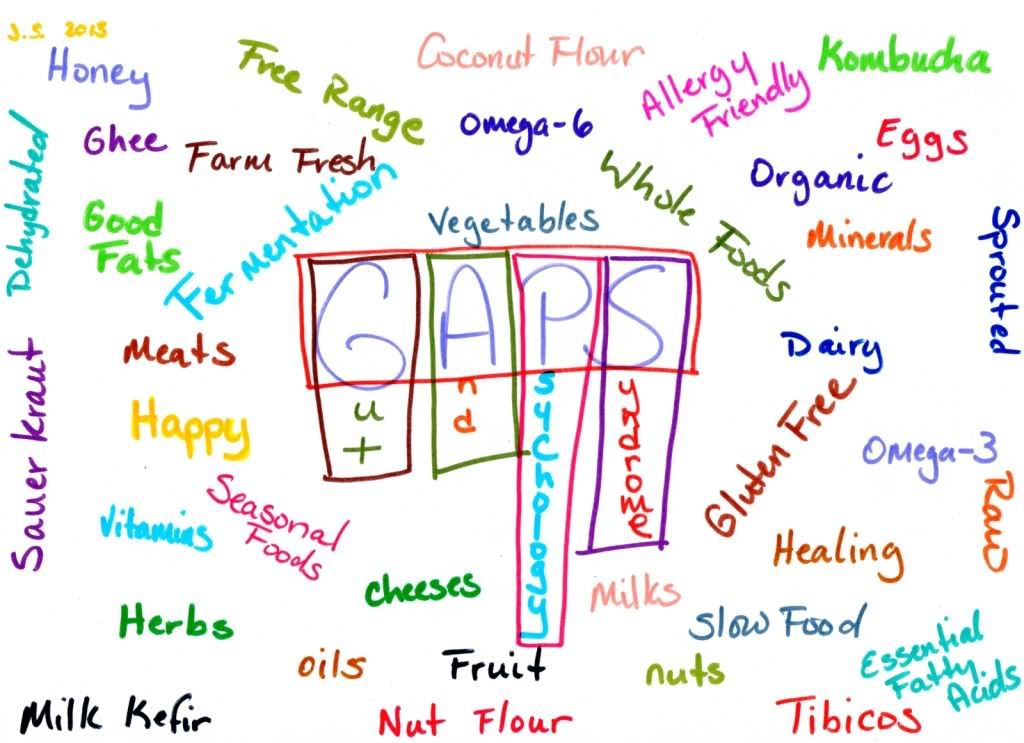
I made this image to reflect a few thoughts I am having about the GAPS Diet. Yes, I know my lines are not perfect. But, it is an effort I'm making to better understand where I see myself going with the GAPS diet. Think of it as a lovely addition to a Vision Board.
The purpose of the diet is to break the ongoing cycle caused by an
overpopulation of harmful bacteria in the gut. When the body is able
to absorb the proper nutrients from simple sugars and other
carbohydrates that are easy to digest, the inflammation and other
complications caused by many autoimmune diseases can be lessened. The
goal is to rid the body of complex saccharides so the gut will be able
to heal itself and enable further healing to occur.
The method of the diet is to keep the bacterial flora well balanced and to allow the gut to digest all of the food it is given, thereby starving out the harmful bacteria.
Certain foods, such as commercial syrups and sugars, starchy
vegetables, and dairy products are not allowed while on the diet. Other
foods, such as fruits, greens, animal protein, and nuts, are allowed.
Source
This is about the Paleo Diet, but also applies to GAPS:
Nuts: Say hello to your new best friend. Nuts are the
best on-the-go protein source for any follower of Paleo. Make sure you
buy them raw without any added seasonings. Nut butter can be safe on
this diet as long as you watch the added oils that may be added. Almond
and sunflower butter are pretty safe bets.
Meats and fish: This duo should be the main attraction on
your meal plate. When buying them, check for added ingredients. Your
protein should be free of any artificial flavors and seasonings, which
is hard to tell in the deli section. If there isn't a visible label,
then just make sure to ask for full disclosure on your poultry, cold
cuts, and other meats. Canned fish is still on the menu for the Paleo
diet and can be a quick time-saver to your salads.
Produce: Lucky for Paleo eaters, this section is pretty
stress-free. Almost anything in the produce section is on limits for the
caveman diet, just steer clear of anything that could be processed or
pasteurized, like bottled fruit or vegetable juice. Kombucha, which is a
naturally fermented black tea, is a good drink to buy in place of your
Odwalla.
Frozen veggies: These can be huge time-savers when you're in a
rush. Keep a selection of veggies like green beans, corn, and spinach
in your freezer to quickly heat up next time you're crunched for time.
Oil: Coconut and olive oils are the best types of oil for
even non-Paleo eaters to keep on hand. Olive oil is great for homemade
salad dressings, while coconut is excellent to cook with. Keep one of
each for variety.
Flavorings: Natural herbs, vinegar, unsweetened applesauce,
and certain broths from concentrate can definitely liven up your food a
bit. Make sure you recognize all the ingredients on the foods list to
watch for added sugars and colorings. Source
Some of this does not apply to GAPS, but keep it in mind for when you eventually will return to a more normalized diet. Remember healthy variation, healthy fats, meats, vegetables, oils, fruits and so on.
Here are a few helpful FAQ-type links about the GAPS diet. They will help in addition to the GAPS-y blog links to your right. Keep in mind though, not all the links to your right are GAPS friendly. They may simply have GAPS OK recipes on there from time to time and I listed them as an encouragement that there are things out there in mainstream recipe sites as well as there may be a day you can return to that kind of diet, if you want to.
Below are some books that have been recommended to me to read about the GAPS diet. These usually do not go on sale, so they are full price. You might can find them used, or possibly at your local public library. I'm kind of SOL in my little village, there aren't many English books at our public library, and when it comes to food related books and the fact I have contact allergies, I would rather just own my own books anyhow.
Below are the books I currently have on my Kindle, because they have GAPS-friendly recipes, and I happened to find them for free or greatly discounted (2€ or less) at the time I got them. Please do keep in mind that Paleo / Primal recipes might need a little tweaking to make it GAPS compliant.
Yesterday I was very pleased to find the Youtube Channel for the "Food Wishes" blog. Being the crazy foodie that I can tend to be, I watched about ten videos, added him to my subscriptions and decided I am going to sit down and cook tomorrow after going grocery shopping. See, our grocery stores and other shops are not open on Sunday. Amazon.de is open, but they don't deliver locally.
I imagined that I would be quite pleased with myself and that my children would be very excited about the wonderful new food choices on their plate. My inner Sheldon Cooper was very excited. It was as if I had received my very own life size Spock cardboard stand-up character.
Yes, I was that excited about trying some really yummy food. In my mind, my kids were not going to be running around like Sheldon Cooper on no sleep, trying to escape the grasp of Leonard Hofstaedter while in a children's ball pit.
My children had other ideas. While we have no ball pit, that's kind of the sounds I heard from the kitchen while my husband was trying to get them to sit and eat. "I want to eat on the floor by the couch!" - "I don't want to eat at all.." followed by "Catch me!"
That's all right though! My youngest ate half of his meat, half of his carrots, tried the bean casserole and peeked over at our servings of Brussels sprouts. My eldest took a couple bites of his meat, ate half of his carrots and only poked at his bean casserole. "Bleh! I'm finished!"
My husband on the other hand, OH MY WORD, that is one of the best duck recipes I have ever had, the absolute most wonderful Brussels sprouts I have ever had, some of the yummiest (would have been better with bone broth in it!) carrots, and an actually very delicious casserole I would not say no to having again.
Without further ado, I present our Food Porn of the night:
The Child's Portioned Plate
The Adult Plates - sorry, the Sprouts got a little burnt while I was distracted
Close up of the Adult Plate.
In the end, both adults had cleared their plates, and the children's plates will be wrapped up and eaten tomorrow.
What in the world did I cook? Well, I used my own recipe of carrots, which consists of putting water in a pot on medium heat, peeling and slicing five thick carrots, putting a heaping teaspoon of honey (your choice which kind!) in the pot of water, some salt and pepper and letting it boil until the carrots are JUST soft. Not crunchy, but not soggy - about like steamed carrots.
Below are the videos that gave me my inspiration for the rest of the meal, and the link to Chef John's blog posts on how to make these, if you are anything like me and need to have a printed copy for your cookbook!
The only changes I made to the Garlic & Blue Cheese Green Bean Almondine was that I am allergic to Blue Cheese - so I used Feta cheese. Since my husband was not keen on the sheep cheese variety, he chose a Balkan Cow's milk based feta. Also, I used smaller garlic knobs and since I am still sensitive to garlic, I used only two very small-small (smaller than the palm of my hand) organic ones.
The Sous Vide Duck was a little labor intensive, but now that we know what temperature our stove will go down to on low (150°F) ... we won't have to babysit it as much next time.
Hopefully next time I will take our sprouts out of the oven a little faster. While slightly burnt, they are a definite repeat in this household.
From the look of things, this would nicely fit into the FULL GAPS diet.
I'm still in beginning stages of GAPS right now, but I figured I can hold myself better accountable if I blog about the different things that I have been finding interesting, difficult or yummy (or G-d forbid, NASTY) while introducing the GAPS Diet to our lifestyle.
Up front I will say that we do not keep a traditional kosher home, but we do keep what I have called "Kosher-Lite". So, we do have dairy with meat, and we do not get exclusively kosher items, though we do eat foods that are categorized as Kosher. Also, we are a Celiac household, so GAPS fits in really well with us. I take a rather free-form look at GAPS and we will use some Paleo (Caveman Diet) and Primal Diet recipes with slight modifications to make them meet the GAPS requirements. I'm also taking some recipes that I've had on hand from magazines, and some from my mom's cookbook that she created when we all went gluten free in 2004.
My household has been a forever gluten free household, though my diet was severely thwarted three years ago and I've been recovering ever since. Due to several issues ongoing with our health, I've decided to slowly transition us over to the GAPS diet to further help our guts heal, and increase our health, lose some weight while we are now beginning to exercise at a gym, and get my kids more interested in a variety of foods.
I'll try to leave some of that story out, because really it's so crazy you'd probably not believe me if I told you how bad things really are right now due to that one incident three years ago.
I'll be posting links in my right-hand sidebar to places I have found GAPS recipes, and have found to be quite helpful in my journey, and at the bottom I will also have some Amazon.com and Amazon.de advertising. My reasons for doing this involve the fact that sometimes it is difficult to find the items, and Amazon is usually great about having things that are not available in your local markets.
I will try and dedicate a few pages to books I have found helpful while navigating the diet, including ones I have on my Kindle reader, as well as the possibility of posting some news items here as this pops up from time to time in the news. (as I remember)
Since I am also blogging over at Yeshua Hineni, and I'm also working on a few online projects + parenting, my blogging goal is to try and blog at the very least, one time a week, and at most, once a day about our GAPS-y meals.
I will be tracking back to blogs I found recipes on, or mentioning where I found them online/in cookbooks and how to get them. Also, I will be posting Food Porn. So be forewarned, make sure you eat BEFORE you come poking around my blog. . . otherwise you might risk short circuiting your mouse and keyboard, Kindle, Tablet or Smart Phone. (hehe)
I hope you enjoy the blog, and that you will comment when you find something particularly interesting to you.